Why “No Results Found” Is Costing You Thousands in Lost Sales
A “No Results Found” message can cost ecommerce stores valuable sales by turning high-intent shoppers away. Learn why traditional keyword search fails and how AI-powered text, voice, and image search can help customers discover relevant products faster, reduce zero-result searches, and create a better shopping experience.
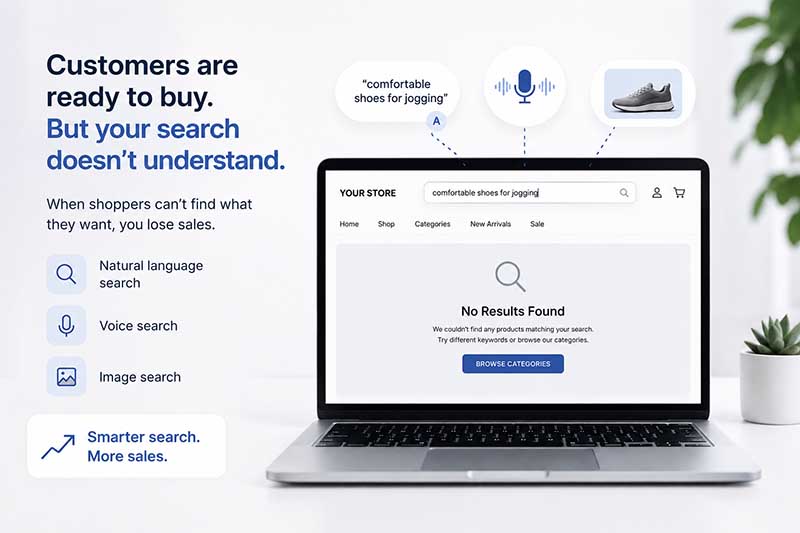
A customer visits your ecommerce store ready to buy. They know what they want, type it into your search bar, and hit enter.
Then they see:
“No Results Found.”
That simple message can turn a high-intent shopper into a lost customer within seconds.
The problem isn't always that you don't sell what they're looking for. Often, your ecommerce search simply doesn't understand the way the customer described it.
This is where AI product search can make a major difference. Solutions like EcomVis AI Product Search can help shoppers discover relevant products through natural-language text, voice, and image searches instead of relying only on exact keywords.
Why Do Ecommerce Searches Return “No Results Found”?
Traditional ecommerce search engines often depend heavily on keyword matching. If a customer's query doesn't closely match your product titles, descriptions, or tags, relevant products may not appear.
Several common problems can cause this.
Poor Keyword Handling
Customers don't always use the same terminology as your product catalogue.
A store might list a product as:
“Men's Lightweight Running Sneakers”
while a customer searches for:
“comfortable trainers for jogging.”
A basic keyword search may struggle to connect the two, even though the product could be exactly what the customer wants.
Misspellings, abbreviations, plural forms, and conversational searches can make the problem even worse.
Limited Product Tagging
Traditional search often depends on manually created tags and product attributes.
If the right keyword isn't included in the catalogue, the search engine may fail to return the product.
This becomes increasingly difficult as an ecommerce store grows from hundreds to thousands of products.
No Synonym Recognition
Customers frequently use different words for the same or similar products:
- Sneakers / Trainers
- Sofa / Couch
- Handbag / Purse
- Mobile phone / Smartphone
If your search engine only understands exact keywords, customers can receive zero results even when matching products are available.
The Hidden Cost of Zero-Result Searches
A failed search isn't simply a poor user experience. It can become a lost revenue opportunity.
People using an ecommerce search bar are often looking for something specific. When the search engine can't help them find it, you create unnecessary friction at a critical point in the buying journey.
Lower Conversion Opportunities
Imagine 1,000 customers searching your store each month.
If only 5% encounter irrelevant or zero results, that's 50 shoppers who may leave without finding what they wanted.
As traffic increases, those missed opportunities can quickly add up.
Higher Exit Rates
Customers have plenty of alternatives online.
If they search your website and immediately receive “No Results Found,” many won't spend time manually browsing categories. They'll simply return to Google or visit another store.
Poor Customer Experience
Modern shoppers are accustomed to intelligent search experiences.
They expect search bars to understand spelling mistakes, synonyms, descriptive phrases, and natural language.
A search engine that repeatedly fails can make even a well-designed ecommerce store feel outdated or difficult to use.
How to Reduce “No Results Found”
The objective shouldn't simply be to remove the message. You need to improve the search experience so customers consistently discover useful products.
1. Add Synonyms and Search Variations
Identify different ways customers describe your products.
If you sell sneakers, for example, your search system may also need to recognize terms such as:
trainers, running shoes, sports shoes, footwear
You should also consider common misspellings, regional terminology, and abbreviations.
2. Improve Your Product Data
Better product information gives search engines more context.
Include useful attributes such as:
- Product type
- Brand
- Colour
- Material
- Size
- Style
- Features
- Intended use
Instead of optimizing product information purely for keywords, describe products in ways that reflect how real customers search.
3. Use AI Product Search
This is where AI product search has an advantage over traditional keyword matching.
Rather than requiring an exact phrase, AI-powered search can interpret the meaning and intent behind a query.
A shopper might search:
“Black backpack for a 15-inch laptop”
or:
“Comfortable shoes for standing all day.”
The exact sentences may never appear in your product descriptions. However, an intelligent search system can use the meaning of the query to identify relevant products.
EcomVis AI Product Search is designed to make this type of ecommerce product discovery easier by allowing customers to search more naturally.
4. Enable Image Search
Sometimes customers know exactly what they want—they just don't know what it's called.
That's particularly common with:
- Fashion
- Furniture
- Jewellery
- Accessories
- Home décor
- Beauty products
With visual product search, shoppers can use an image to discover visually relevant products rather than trying to describe them with keywords.
This removes another major cause of failed searches.
5. Give Customers More Ways to Search
Typing isn't the only way people interact with technology.
Combining text, voice, and image search allows customers to choose the method that's easiest for them.
EcomVis brings these search methods together, helping ecommerce stores create a more flexible product discovery experience.
Turn Failed Searches Into Product Discovery
Even an advanced search system won't always have an exact match. Perhaps the product is unavailable or simply isn't in your catalogue.
But that doesn't mean the experience should end with a blank page.
Instead, consider showing:
- Similar products
- Related categories
- Alternative products
- Popular searches
- Best-selling products
- Suggested search terms
The objective is simple:
Never leave a shopper at a dead end.
If you can't provide the exact product, help them discover the next-best option.
How ecomvis AI Product Search Can Help
EcomVis AI Product Search helps ecommerce businesses move beyond basic keyword matching and create a more intuitive search experience.
With AI-powered text, voice, and image product search, shoppers can search in ways that feel natural instead of trying to guess which keywords your website understands.
For ecommerce businesses, better product discovery can mean:
- Fewer zero-result searches
- More relevant search results
- Easier product discovery
- Better customer experiences
- More opportunities for conversion
Instead of forcing shoppers to adapt to your search engine, your search engine can become better at understanding your shoppers.
Conclusion
Every “No Results Found” message deserves attention.
A customer has already visited your store, expressed an interest, and told you what they're looking for. Failing to connect that customer with a relevant product can mean losing a valuable sales opportunity.
Improving product data, recognizing synonyms, providing alternative recommendations, and adopting AI-powered product search can transform ecommerce search from a frustrating navigation tool into an effective product discovery experience.
With EcomVis AI Product Search, ecommerce stores can offer intelligent text, voice, and image search to help customers find relevant products faster.
Because when shoppers find what they're looking for, they're much more likely to keep moving toward checkout.