Best Search Solutions for Shopify Stores AI, Voice & Image Search
Discover the best search solutions for Shopify stores and learn how AI-powered natural language, voice, and image search can improve product discovery, help shoppers find products faster, and create more opportunities to increase conversions and sales.
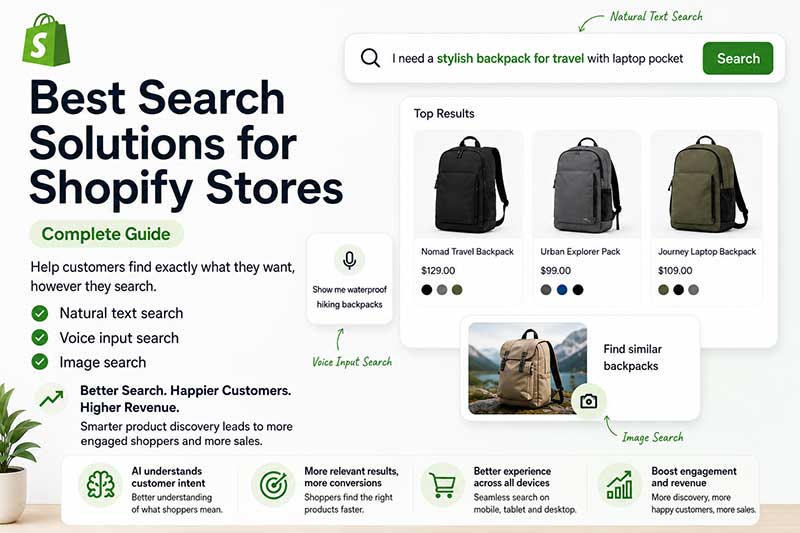
Introduction
Shopify powers millions of stores - but simply having great products doesn't mean customers can easily find them.
When shoppers know what they want but your store search fails to understand their intent, product discovery becomes a barrier to purchase.
One customer might type:
"comfortable black shoes for standing all day"
Another might prefer to use voice search, while someone with a photo of a product they like may want to search using an image.
Modern shoppers don't always use short, perfectly structured keywords. That's why choosing the best search solution for your Shopify store can improve product discovery, customer experience, and conversion opportunities.
In this guide, we'll explore Shopify search solutions and how AI product search, natural-language search, voice search, and visual search can create a smarter shopping experience.
Why Shopify Product Search Matters
Imagine walking into a store and asking:
"I need a lightweight waterproof backpack that fits my laptop and works for weekend trips."
Now imagine being told:
"Sorry, I couldn't find an exact keyword match."
That's essentially what can happen when ecommerce search depends too heavily on keywords.
Customers don't necessarily know your:
- Product titles
- Categories
- Tags
- Attributes
- Catalog terminology
A good ecommerce search solution should reduce that burden and connect customer intent with relevant products quickly.
What Makes a Good Shopify Search Solution?
The best solution depends on your catalog, customers, and budget, but useful capabilities include:
- Fast, relevant results
- Autocomplete
- Typo tolerance
- Synonym support
- Product attribute matching
- Filters
- Natural-language understanding
- Semantic search
- Mobile-friendly search
- Voice input
- Image search
- Search analytics
For modern Shopify stores, one of the most important questions is whether search can understand what customers mean, rather than simply matching individual keywords.
Shopify's Built-In Search
For new or smaller Shopify stores, native search can provide a practical starting point.
It may be sufficient when you have:
- A relatively small catalog
- Straightforward product names
- Simple categories
- Customers using predictable keywords
A query such as:
"blue handbag"
is straightforward.
But consider:
"I need an elegant blue handbag that's large enough for work but not too bulky."
The second query communicates much more intent. This is where more advanced semantic and AI-powered search can become valuable.
AI Product Search for Shopify
AI product search goes beyond simple keyword matching.
Depending on the implementation, it can interpret:
- Natural language
- Context
- Product meaning
- Multiple requirements
- Customer intent
- Related terminology
For example:
"Find me a lightweight jacket for travelling somewhere warm but rainy."
The shopper has communicated several requirements:
Product: JacketUse case: TravelClimate: WarmWeather: RainPreference: Lightweight
An AI product-search system can attempt to interpret those requirements and identify relevant products.
This can make ecommerce search feel more like communicating with a knowledgeable shopping assistant.
Natural-Language Search for Shopify
Natural-language search allows shoppers to search the way they naturally speak or write.
Instead of:
"weekender bag black leather men"
they can search:
"Show me a stylish black weekender bag for men that's suitable for a short business trip."
That tells the search system much more about what the customer wants.
Why Natural-Language Search Matters
Traditional search often requires customers to adapt their language to the search engine.
AI search aims to reverse that relationship:
Instead of customers adapting to search, search adapts to customers.
This can be particularly valuable for stores with products that have many attributes, styles, or use cases.
Voice Search for Shopify
Typing detailed queries on a smartphone isn't always convenient.
With voice product search, a shopper could tap a microphone and say:
"Show me a waterproof hiking backpack with a laptop compartment under $150."
Voice input can:
- Reduce typing
- Make detailed searches easier
- Improve mobile convenience
- Encourage more natural queries
The important part isn't simply adding a microphone.
Voice becomes much more useful when combined with AI natural-language search capable of understanding what the shopper says.
Visual and Image Search for Shopify
Sometimes customers don't know what to type.
They simply know:
"I want something like this."
With visual search for Shopify, shoppers can provide an image and use it as their search query.
They might upload a picture of:
- A handbag
- Shoes
- A dress
- Jewelry
- Furniture
- Home décor
The search system can then attempt to identify relevant or visually similar products from the store's catalog.
Why Image Search Matters
Imagine a shopper sees a handbag on social media.
They like its shape, color, material, and style-but don't know whether it's called a tote, satchel, hobo bag, or shoulder bag.
Without visual search, they have to translate what they see into keywords.
With image search:
See it → Upload it → Find relevant products.
Visual search can be especially useful for fashion, furniture, jewelry, accessories, home décor, and other visually driven ecommerce categories.
Text vs Voice vs Image Search
These search methods solve different customer problems.
| Search Method | Best When the Shopper... | Example |
|---|---|---|
| Keyword Search | Knows the product | "Black backpack" |
| Natural-Language Search | Can describe the need | "Backpack for weekend flights that fits my laptop" |
| Voice Search | Prefers speaking | Says the detailed request |
| Image Search | Knows how it should look | Uploads a reference photo |
A modern Shopify search experience can therefore give customers multiple ways to communicate:
Type it. Say it. Show it.
Don't Forget Filters, Typos and Synonyms
AI search doesn't make traditional ecommerce search features unnecessary.
After searching for:
"comfortable women's running shoes"
a shopper may still want to filter by:
- Size
- Brand
- Color
- Price
- Material
- Availability
Good search should also account for spelling mistakes such as:
"snikers" → "sneakers"
and different terminology:
Sneakers → TrainersDuffle bag → Weekender bagCouch → Sofa
Combining intelligent search with useful filters creates a more complete product-discovery experience.
Search Analytics Matter
Your search box can provide valuable customer-intent data.
Search analytics can reveal:
- What customers want
- How they describe products
- Which searches return no results
- Products customers struggle to find
- Potential gaps in your catalog
For example, if customers repeatedly search:
"waterproof laptop backpack"
and you sell one but it doesn't appear, you may have a search problem.
If you don't sell one, you may have identified a merchandising opportunity.
How Better Shopify Search Can Support Revenue Growth
Installing AI search doesn't automatically increase sales.
Revenue depends on many factors, including product demand, pricing, traffic quality, trust, shipping, checkout experience, and merchandising.
However, search influences an important part of the buying journey:
Customer arrives → Expresses intent → Search understands intent → Relevant products appear → Purchase opportunity
Compare that with:
Customer arrives → Searches → Irrelevant results → Searches again → No results → Leaves
Better search is about reducing friction between customer intent and relevant products.
This is particularly important if you're already spending money on SEO, Google Ads, Meta Ads, social media, or influencer marketing.
Instead of only buying more traffic, improving search can help you get more value from the visitors you've already attracted.
How Ecomvis AI Product Assistant Can Help Shopify Stores
For Shopify merchants looking to move beyond conventional keyword search, Ecomvis AI Product Assistant gives shoppers multiple ways to find products.
💬 Natural-Language Text Search
Customers can describe what they're looking for conversationally.
For example:
"I need a spacious weekender bag that's stylish enough for business travel and fits a laptop."
Instead of guessing the right keywords, the shopper simply describes the requirement.
🎙️ Voice Input Search
Customers can speak their product request instead of typing it.
This can be especially useful for mobile shoppers entering longer, more detailed queries.
📷 Image Search
Customers can provide an image and use it as the starting point for product discovery.
If someone knows what a product should look like but doesn't know what to call it, an image can communicate that intent directly.
One Product Assistant, Three Ways to Search
The concept is simple:
TYPE IT 💬
Describe what you're looking for naturally.
SAY IT 🎙️
Speak your product request.
SHOW IT 📷
Provide an image and search visually.
For Shopify merchants, the value isn't simply having three AI features.
It's giving customers more intuitive ways to communicate purchase intent.
Example: Traditional Search vs AI Search
Imagine a shopper looking for a dress.
Traditional search:
"dress"
The store might return hundreds of products.
Natural-language search:
"I'm looking for an elegant blue midi dress for an outdoor summer wedding."
Now the shopper has communicated:
- Product: Dress
- Color: Blue
- Length: Midi
- Style: Elegant
- Occasion: Wedding
- Season: Summer
An AI-powered product assistant can attempt to use these details to surface more relevant options.
Choosing the Best Search Solution for Your Shopify Store
Before selecting a solution, ask:
How do customers search?
Do they use product names, attributes, long descriptions, or use cases?
Is your store highly visual?
If appearance strongly influences purchases, image search may be valuable.
How important is mobile traffic?
High mobile usage can make voice input particularly useful.
Do customers use complex queries?
If so, natural-language and semantic search deserve attention.
Does the solution provide analytics?
You need to understand how customers use search and whether results improve.
What does it cost?
Compare pricing with your catalog size, search volume, traffic, integration effort, and potential business value.
Don't choose a search platform simply because it has the longest feature list.
Choose one that solves your customers' actual search problems.
Shopify Search Solution Checklist
When comparing Shopify search solutions, consider:
Fast product results
Accurate relevance ranking
Mobile-friendly interface
Autocomplete
Typo tolerance
Synonym handling
Natural-language search
Semantic search
Voice input
Image/visual search
Product filters
Search analytics
Easy Shopify integration
Customizable branding
Scalable pricing
You may not need every feature. Focus on the capabilities that solve real customer problems.
How to Test a Shopify Search Solution
Don't test search using only exact product titles.
Try realistic customer queries:
Simple:"black bag"
Multiple attributes:"black leather laptop bag"
Natural language:"I need a black bag that fits my laptop and looks professional for work."
Use case:"bag for a three-day business trip"
Typo:"lether laptop bag"
Voice:Speak a detailed product request on your phone.
Image:Upload a real screenshot or photograph.
Compare the relevance, speed, mobile experience, and number of zero-result searches.
Does AI Search Help Shopify SEO?
AI product search and Google SEO are different things.
Installing AI search does not automatically improve Google rankings.
However, internal search data can support your SEO strategy by revealing the language customers actually use.
If shoppers repeatedly search:
"lightweight backpack for budget airlines"
that could inspire improvements to:
- Product descriptions
- Category pages
- FAQs
- Buying guides
- Blog posts
- Landing pages
Your internal search data can therefore become a useful source of long-tail keyword and customer-intent ideas.
Frequently Asked Questions
What is the best search solution for Shopify?
There isn't one solution that's best for every store. The right choice depends on catalog size, customer behavior, budget, mobile usage, and whether you need features such as natural-language, voice, semantic, or visual search.
What is AI product search for Shopify?
AI product search uses technologies such as natural-language processing and semantic matching to interpret shopper intent and identify relevant products beyond exact keyword matching.
Can Shopify customers search using images?
Compatible visual-search or AI-search solutions can allow shoppers to provide an image and use it to discover relevant or visually similar products.
Can Shopify support voice search?
Voice input can be provided through compatible search technologies, allowing shoppers to speak product queries rather than type them.
What is natural-language ecommerce search?
Natural-language search lets customers describe what they want conversationally-for example, "comfortable black shoes for standing all day"-instead of using short catalog keywords.
Can better Shopify search increase sales?
Better search can reduce product-discovery friction and help shoppers reach relevant products, creating more opportunities for conversion. However, search technology alone cannot guarantee increased revenue.
Final Thoughts
The best Shopify search solution isn't necessarily the one with the most features.
It's the one that makes it easiest for your customers to find relevant products.
For some stores, traditional keyword search and filters may be enough.
For others, shoppers increasingly benefit from more intuitive options:
💬 Describe what they need.
🎙️ Say what they're looking for.
📷 Show what they want.
AI-powered product assistants such as Ecomvis can bring natural-language, voice, and image search together, giving Shopify shoppers multiple ways to communicate their intent.
Ultimately, customers shouldn't have to learn how your search engine thinks.
Your search experience should understand how your customers shop.