AI Ecommerce Search API: A Practical Global Guide
Learn how AI ecommerce search APIs combine semantic, visual, and voice search...

An AI ecommerce search API helps online stores understand what shoppers mean, not only the exact words they type. From my experience reviewing search journeys, the strongest implementations begin with clean catalog data and measurable customer needs-not an impressive demo. This guide explains the architecture, evaluation process, integration steps, and operational habits that turn intelligent search into a dependable product-discovery system for worldwide commerce.
An AI ecommerce search API is a software interface that connects a store’s product catalog to machine-learning search. It interprets natural-language, image, or voice queries; retrieves relevant products; ranks them using context and business rules; and returns structured results that a website, app, or conversational widget can display.
Table of Contents
- Why ecommerce search needs an AI layer
- How an AI ecommerce search API works
- Core capabilities to evaluate
- AI search compared with conventional search
- Catalog preparation and indexing
- A practical implementation checklist
- Relevance, speed, and worldwide readiness
- Security, privacy, and governance
- Measurement and continuous improvement
- Common implementation mistakes
- People Also Ask
- Expert Q&A
- Conclusion
Why Ecommerce Search Needs an AI Layer
Store search is different from general web search. A shopper may know a SKU, describe a use case, mention a budget, upload a photo, or speak a loose idea such as “a compact lamp for a dark reading corner.” Each query expresses intent in a different form. Therefore, a useful system must connect words, attributes, images, availability, and commercial context.
Traditional keyword search can work well for exact product names and clean catalog fields. However, it often breaks when shoppers use synonyms, misspellings, regional wording, or multiple constraints. A search for “trainers below 80 dollars” should understand that “trainers” may mean sneakers, that the price is a filter, and that currency and market context matter. It should not depend on every phrase being manually configured.
The need is significant. According to the Baymard Institute’s ecommerce search UX research, roughly half of tested participants preferred search as their product-finding route, while 56% of benchmarked ecommerce sites failed to support search needs adequately. That gap creates a practical opportunity: improve discovery before spending more to acquire traffic.
Yet AI is not a substitute for merchandising discipline. If product records lack reliable titles, prices, categories, image URLs, stock status, or variant relationships, even a strong model has weak material to work with. In practice, the best search programme combines machine understanding with accurate data, clear user experience, and regular evaluation.
How an AI Ecommerce Search API Works
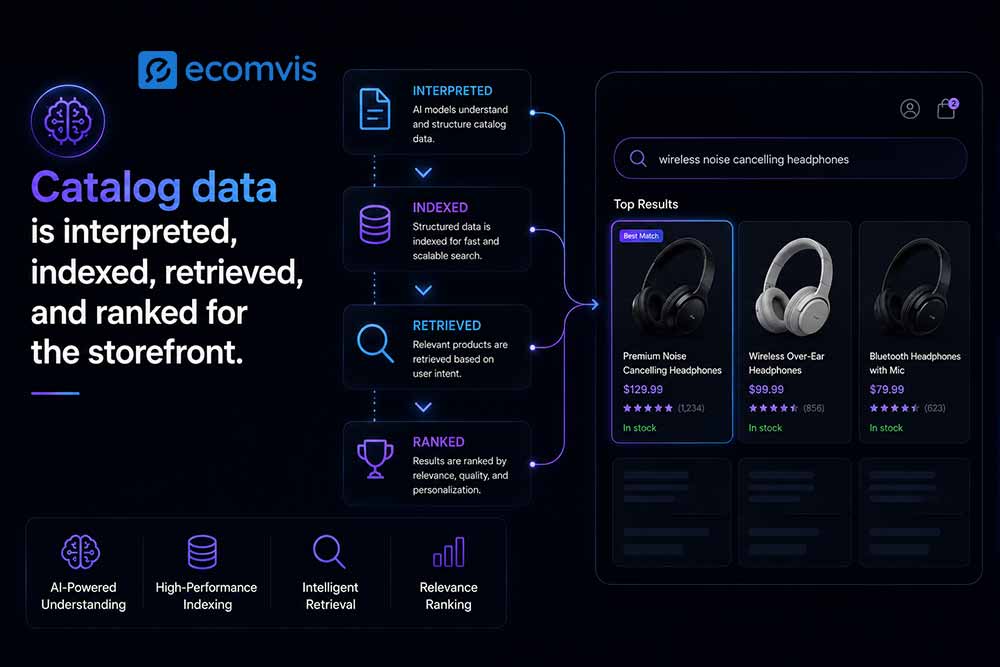
An AI ecommerce search API usually sits between the shopper-facing interface and a prepared product index. The storefront sends a query and context. The service interprets that request, finds candidates, ranks them, and returns structured product data. The interface then renders product cards, filters, suggestions, or a conversational answer.
1. Catalog ingestion
First, the system receives product records from a spreadsheet, feed, platform connector, or direct API. Typical fields include product ID, title, description, category, attributes, price, currency, image URL, product-page URL, availability, and locale. Variant-level data is also important when size, colour, or material affects whether a result is genuinely useful.
2. Normalisation and enrichment
Next, the service cleans and normalises fields. For example, “navy,” “midnight blue,” and “dark blue” may need a shared colour relationship without becoming identical. Units, currencies, sizes, and category paths also need consistent treatment. Some systems create vector embeddings, which are numerical representations of semantic or visual meaning.
3. Query understanding
When a shopper searches, the API identifies likely intent and constraints. A natural-language query such as “waterproof hiking backpack for a weekend under €120” contains product type, feature, use case, and price. Meanwhile, an image query may represent shape, colour, pattern, or overall visual similarity. Voice input adds transcription, punctuation, language, and ambient-noise concerns.
4. Candidate retrieval
The engine finds a broad but relevant candidate set. Many systems use hybrid retrieval, combining lexical matching with semantic vectors and structured filters. This is often safer than relying on one method. Exact SKU searches need precise lexical behaviour, while descriptive queries benefit from semantic understanding.
5. Ranking and business controls
The system ranks candidates using relevance signals. It may also apply stock rules, market availability, merchandising boosts, freshness, popularity, margin, or campaign settings. However, commercial boosts should not overpower intent. A promoted item that does not match the request weakens trust.
6. API response and rendering
Finally, the API returns structured results, usually as JSON. A response may contain product identifiers, result scores, matching attributes, images, prices, links, facets, pagination data, and query metadata. The storefront controls presentation, while the search service controls interpretation and ranking.
Core AI Ecommerce Search API Capabilities to Evaluate
A vendor checklist should begin with the queries and platforms the store actually supports. A fashion marketplace and an industrial-parts supplier have different relevance needs. Nevertheless, several capabilities apply widely.
Natural-language and semantic search
Semantic search connects intent with catalog meaning. It can recognise that “office chair for a small apartment” relates to compact dimensions, ergonomic features, and furniture categories even when that full phrase never appears in a title. Still, it must preserve exact matching for model numbers, brands, and SKUs.
Visual product search
Visual search lets a shopper upload a photo or screenshot and receive similar products. It is especially useful for fashion, furniture, jewellery, décor, and other visually led categories. The Google Cloud product-search learning guide describes a comparable pattern: reference images represent catalog products, and a query image returns visually and semantically similar ranked results.
Image matching should not rely on colour alone. Shape, category, texture, pattern, and context may matter more. Therefore, testing should include difficult cases, such as a chair photographed in a furnished room, a cropped garment, or a low-light phone image.
Voice search
Voice search reduces typing effort, especially on mobile. However, speech-to-text is only the first step. The search layer must still understand product intent, numbers, units, brands, and local accents. It should also allow the shopper to review or correct the transcript before search when accuracy is uncertain.
Filters, facets, and structured constraints
AI retrieval works best when it cooperates with structured commerce data. Price, size, availability, delivery region, rating, compatibility, and material often need deterministic filters. For example, a semantically similar shoe in the wrong size is not a useful result. The API should return facets and preserve selected constraints as the query evolves.
Typo tolerance and synonyms
Misspellings, plural forms, transliteration, alternate spellings, and regional vocabulary are normal worldwide. Good systems manage them without making every query fuzzy. Excessive tolerance can merge different brands or technical part numbers. Therefore, exact identifiers should have stricter rules than descriptive language.
Multilingual and multi-market controls
A worldwide store may serve multiple languages, currencies, stock pools, and legal markets. Ask whether indexing is shared or locale-specific, how language is detected, and whether results can be filtered by market. Also confirm that local product titles and alternate spellings remain searchable.
Analytics and explainability
Useful analytics include query volume, zero-result rate, click-through rate, add-to-cart after search, reformulations, latency, and popular filters. Teams also need enough explanation to diagnose ranking. A score alone rarely tells a merchandiser why a result appeared.
AI Search Compared with Conventional Ecommerce Search
| Evaluation area | Conventional keyword search | AI ecommerce search API |
|---|---|---|
| Query matching | Relies mainly on terms and configured rules | Combines terms, meaning, attributes, and context |
| Descriptive requests | Often needs manual synonyms | Can interpret longer natural-language intent |
| Images and voice | Usually separate tools | Can unify text, voice, and image inputs |
| Exact SKUs | Often strong | Must preserve an exact-match path |
| Catalog setup | Field mapping and rule tuning | Field mapping, indexing, model preparation, and evaluation |
| Merchandising | Manual boosts and redirects | Rules can combine with learned relevance |
| Transparency | Rules are often easier to inspect | Requires good analytics and debugging tools |
| Best fit | Small, predictable catalogs and exact queries | Diverse catalogs, richer intent, and multimodal discovery |
The choice is not always binary. Hybrid search often provides the safest production design. Exact term matching can protect SKUs and product names, while semantic or visual retrieval handles discovery. Then a ranking layer can combine both sources and apply availability rules.
Prepare the Product Catalog Before Indexing
Catalog quality sets the ceiling for search quality. Before integration, audit the feed from a shopper’s perspective. Could a person understand what each item is, who it suits, and which choices are available? If not, the search engine may also struggle.
Essential fields
At minimum, provide a stable product ID, clear title, useful description, canonical URL, primary image, category, price, currency, availability, and market. Add meaningful attributes such as colour, material, dimensions, gender, compatibility, or technical specifications where relevant.
Avoid stuffing unrelated keywords into descriptions. Instead, write factual product language and keep structured facts in structured fields. This makes filtering more reliable and reduces accidental matches.
Product and variant relationships
Decide whether the searchable unit is a parent product or a variant. Returning twelve colour variants as twelve nearly identical results may crowd the page. Conversely, hiding variants can make a specific colour or size appear unavailable. A practical approach is to rank parent products while exposing matching variant details.
Images
Use clear, accessible images with stable URLs. Multiple views can improve visual matching, especially when a category depends on silhouette or detail. Nevertheless, do not let lifestyle photography replace a clean product view. A mixed set often works best.
Freshness and deletion
Define how updates reach the index. Prices, stock, links, and products change continuously. Full catalog replacement may be simple for small stores, while incremental updates are better for large or frequently changing catalogs. In either case, test deletion. Outdated products should not remain discoverable because a removal event was missed.
AI Ecommerce Search API Implementation Checklist
Use this sequence to keep the project measurable and reversible.
- Define the business and user problem. Identify weak query types, zero-result patterns, mobile friction, or visual-discovery needs. Set a baseline before changing the engine.
- Collect representative queries. Include exact products, categories, features, use cases, compatibility, budgets, misspellings, long phrases, images, and voice samples from relevant markets.
- Audit catalog fields. Fix missing identifiers, inconsistent categories, weak descriptions, broken images, stale availability, and unclear variants.
- Choose the integration surface. Decide between a ready-made widget, a storefront plugin, a headless API, or a phased combination. Confirm support for Shopify, WooCommerce, Webflow, Wix, React, Next.js, or custom HTML as required.
- Map the data contract. Document required fields, types, allowed values, update frequency, authentication, error handling, and deletion behaviour.
- Build a staging index. Keep early tests away from live shoppers. Upload a representative catalog and verify product counts, markets, images, and variants.
- Create relevance judgements. For important test queries, label expected products as highly relevant, acceptable, or irrelevant. Include hard negatives that look similar but are wrong.
- Test the interface. Check autocomplete, loading, empty states, filters, keyboard navigation, image upload, microphone permission, mobile layout, and product links.
- Set performance budgets. Measure total user-perceived time, not only server response. Include network travel, browser rendering, image loading, and third-party scripts.
- Protect the API. Keep secret credentials off the client, restrict public keys where supported, validate uploads, rate-limit requests, and monitor unusual traffic.
- Release gradually. Use an internal trial, a small traffic percentage, or selected markets. Maintain a rollback path to the previous search.
- Measure outcomes. Compare relevance, zero-result rate, search exits, clicks, carts, revenue per search, latency, and support feedback. Treat conversion changes as evidence only when the experiment is adequately controlled.
Relevance, Speed, and Worldwide Readiness
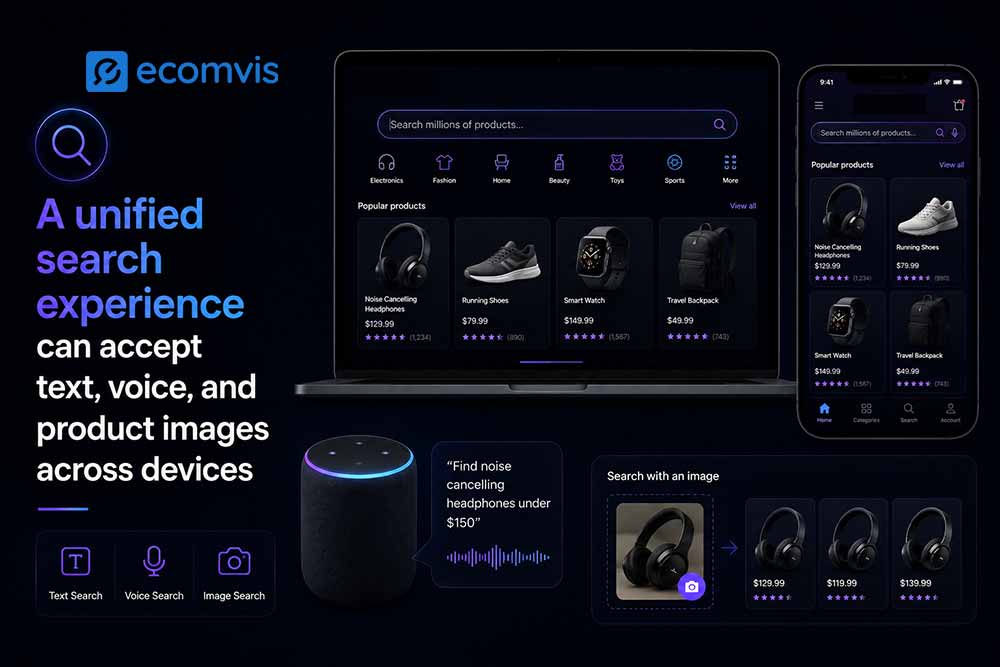
Search quality has three connected dimensions: whether results are correct, whether they arrive quickly, and whether they respect local context. Optimising only one can harm the others.
Build a relevance test set
Start with real queries from analytics and customer-support conversations. Then add coverage for new features and markets. Each test query should have expected results or clear relevance criteria. Run the set after catalog changes, model updates, synonym edits, and ranking-rule changes.
Measure more than “did something appear?” Useful offline metrics include precision at the first few positions, recall, and normalised discounted cumulative gain. However, non-technical teams can begin with a simpler graded scorecard: excellent, acceptable, poor, or zero-result.
Protect exact intent
An AI layer should not make obvious queries unpredictable. Exact SKUs, model numbers, quoted phrases, and complete product names need protected logic. Likewise, a restrictive request such as “red cotton shirt size medium” should not return a popular polyester shirt merely because it performs well commercially.
Design graceful zero-result recovery
Some zero-result searches are valid because the catalog lacks the product. The experience should still help. Show corrected spelling, related categories, relaxed filters, alternate products, or a way to browse. Never silently remove an important constraint without telling the shopper.
Manage end-to-end latency
API response time is only part of perceived speed. A fast result payload can still feel slow if the widget blocks the main thread or loads oversized product images. Performance work should cover the whole journey. A recent web.dev ecommerce case study reported that an image-prioritisation strategy improved Largest Contentful Paint by 68% and was associated with 8.9% more conversions in that implementation. It is a case study, not a universal guarantee, but it shows why search results must render efficiently.
Use caching carefully. Popular anonymous queries may be cacheable, while personalised prices or stock require tighter controls. Also set timeouts and fallbacks. If an advanced query fails, the interface should recover with a useful message or a simpler search path.
Localise beyond translation
Worldwide readiness includes language, spelling, currency, units, sizes, catalog availability, and product naming. “Jumper,” “sweater,” and “pullover” may overlap, while shoe sizes differ by region. Keep locale and market in the request so ranking and filters use the correct context.
Security, Privacy, and Governance
An API integration creates administrative responsibilities. The following points are operational guidance, not legal advice; privacy and regulatory decisions should be reviewed by qualified professionals for each market.
Keep private API credentials on a trusted server. If a browser must use a public token, restrict its domain, permissions, quota, and lifetime where the service supports those controls. Moreover, rate-limit endpoints and log failures without exposing sensitive payloads.
Image and voice inputs deserve special care. Explain what is uploaded, why it is processed, how long it is retained, and whether it trains any model. Avoid collecting data that the search task does not require. In addition, validate file type and size, scan uploads as appropriate, and remove metadata that is unnecessary.
Define roles for catalog updates, ranking rules, analytics access, and incident response. Then keep a change log. When search behaviour shifts, the team should be able to connect the change to a catalog import, model version, rule edit, or storefront release.
Finally, assess vendor portability. Ask how to export queries, analytics, relevance rules, and catalog mappings. A clear exit path reduces operational risk and encourages disciplined data ownership.
Measure and Improve AI Ecommerce Search
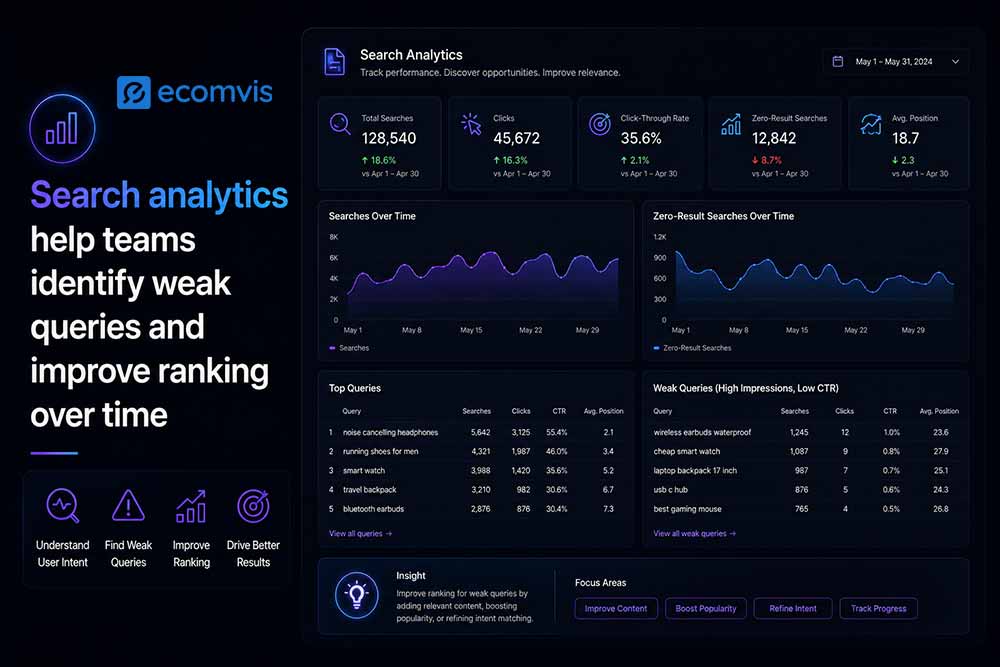
Search optimisation is an ongoing product process. A launch proves that the integration works; it does not prove that ranking serves customers well.
Establish a balanced dashboard
Use a small group of diagnostic and outcome metrics:
- Search usage rate: the share of sessions that use search.
- Zero-result rate: the share of queries with no products returned.
- Result click-through rate: whether shoppers engage with returned items.
- Query reformulation rate: how often users quickly try a different phrase.
- Search exit rate: whether users leave after viewing results.
- Add-to-cart after search: a useful intent signal, though not a complete conversion measure.
- Revenue per search session: valuable when interpreted alongside traffic mix and experiments.
- Latency and error rate: essential reliability indicators.
Segment these metrics by device, country, language, query type, new versus returning user, and search mode. An overall average can hide a broken mobile voice journey or a weak locale.
Review query clusters, not isolated anecdotes
One strange query can attract attention without representing meaningful demand. Group similar queries and examine patterns. For example, many searches for “quiet fan,” “silent desk fan,” and “low-noise office fan” indicate one intent cluster and a possible catalog-attribute gap.
Use controlled experiments
When traffic allows, compare meaningful search changes through A/B tests. Keep the hypothesis specific: “Adding attribute-aware ranking for compatibility queries will reduce reformulation.” Then predefine primary and guardrail metrics. Avoid attributing every sales increase to search when promotions, seasonality, stock, or marketing changed at the same time.
Maintain a human review loop
Analytics reveal where to look; human judgement explains why. Schedule reviews with merchandising, support, product, and engineering teams. Examine top queries, zero results, low-click results, harmful mismatches, and market-specific issues. Then convert findings into catalog fixes, synonyms, rules, interface changes, or model evaluations.
Common AI Ecommerce Search API Mistakes
Choosing from a demo alone
A polished demo usually uses clean data and favourable queries. Test your own catalog, images, languages, SKUs, and awkward requests. Ask how long indexing takes and how failures are reported.
Replacing exact search with semantic search
Semantic similarity is not accuracy for every query. Preserve strict handling for identifiers and precise constraints. Hybrid retrieval is usually more robust.
Ignoring the results interface
Good ranking can be weakened by slow images, unclear filters, inaccessible controls, or an empty-state dead end. Search is a complete journey from entry to product page, not merely an endpoint.
Using conversion as the only metric
Conversion is affected by price, stock, shipping, promotions, and traffic quality. Pair it with relevance, clicks, reformulation, exits, latency, and qualitative review.
Launching without rollback
Catalog errors, vendor incidents, or unexpected ranking shifts happen. Keep the previous search available, use feature flags, and document who can roll back.
People Also Ask About AI Ecommerce Search APIs
What is an AI ecommerce search API?
It is an interface that lets a storefront send product-search requests to an AI-powered service. The service interprets intent, retrieves catalog products, ranks them, and returns structured results for the store to display.
Can an AI ecommerce search API support images and voice?
Yes, if the service is multimodal. Image search compares visual features with catalog images, while voice search converts speech to text before intent processing and retrieval. Both require careful privacy, UX, and error handling.
Does AI search replace product filters?
No. AI can interpret descriptive intent, but structured filters remain important for price, size, availability, compatibility, and delivery region. Strong systems combine semantic understanding with deterministic constraints.
How long does integration take?
It depends on catalog quality, platform, interface scope, and testing. A widget may be quick to install, while a custom headless experience needs data mapping, security work, relevance evaluation, analytics, and staged rollout.
Is AI ecommerce search suitable for small stores?
It can be, especially when shoppers use descriptive or visual queries. However, a small store should compare the expected discovery benefit with catalog effort, usage cost, and operational capacity.
Expert Q&A
How should a team evaluate search relevance before launch?
Build a representative query set from analytics, support messages, and target markets. Label expected results, include hard negative examples, and score the first several positions. Re-run the same test after each meaningful catalog, model, or ranking change.
What should an API response contain?
At minimum, expect stable product IDs, ranked results, product URLs, image references, prices, availability, and pagination. Depending on the experience, also request facets, matching attributes, query IDs, confidence or score fields, correction suggestions, and debugging metadata.
How can a store prevent AI ranking from showing unavailable products?
Send fresh availability data and apply it as a hard filter or strong rule. Confirm how quickly updates reach the index, test deletion and regional stock, and use a final server-side availability check before checkout.
What is the safest way to customise ranking?
Start with customer relevance, then add limited business signals such as stock, freshness, or merchandising priorities. Measure each rule, cap aggressive boosts, and maintain a rollback path. Never let paid or promoted status silently override a shopper’s core constraints.
How should teams compare AI search vendors?
Use the same catalog, query set, locales, traffic assumptions, and success metrics for each evaluation. Compare relevance, multimodal quality, latency, update speed, security, analytics, platform flexibility, support, pricing predictability, and data portability-not feature lists alone.
Conclusion
An AI ecommerce search API can make product discovery more natural by combining exact terms, semantic meaning, structured filters, images, and voice. However, durable results depend on catalog quality, protected exact matching, fast rendering, market context, privacy controls, and continuous evaluation.
Begin with a real query baseline. Clean the catalog, test a representative index, measure user outcomes, and release gradually. If you want one interface for text, voice, and image discovery across common ecommerce platforms or a custom storefront, explore the Ecomvis AI product discovery platform and compare its fit against your own relevance, performance, security, and operational requirements.